The benefits of companion plants can be best expressed by starting with the
The Legend of the Three Sisters:
By Jane Taylor, PLG Garden Coordinator at Pioneer Union School in Somerset, CA
The Cherokee Native Americans have a legend about three sisters that teaches us how the Cherokee successfully and efficiently grew their squash, beans, and corn together.
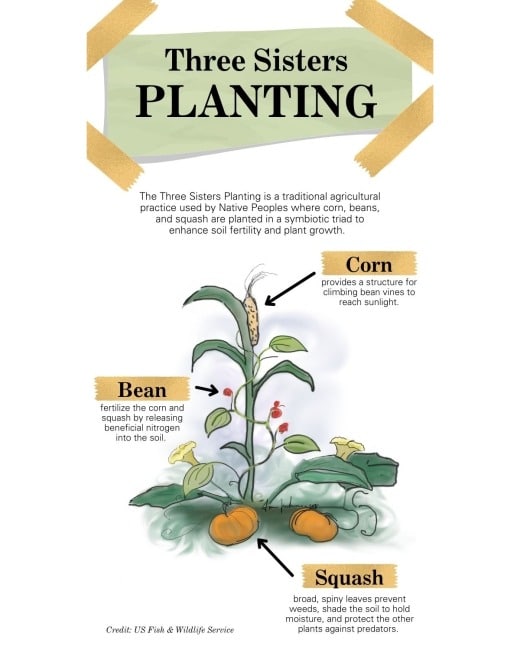
There once lived three sisters…
The first one was tall and had long yellow hair; her name was corn girl. She grew upright and strong, but her feet would get sunburned from standing in the field all day. She was also very hungry. The second sister was very fast and good at making food, but she wasn’t very strong and couldn’t stand up on her own. All day, she sat in the dirt wishing she could grow tall; her name was bean girl. The third sister was very plump and round, and she was very hungry. Her name was squash girl. The three sisters never got along.
Then one day, bean girl said to corn girl, “If you are so hungry, why don’t I feed you, and you can hold me up so I don’t get so dirty?” Corn girl agreed; now she was no longer hungry, and bean girl was no longer dirty on the ground. Squash girl said, “Why don’t I sit by your feet, corn girl, to keep them in the shade so they won’t get sunburned, and in exchange, bean girl can give me food too!” The three sisters learned to work together, which is why Native Americans always plant their beans, corn, and squash together! Corn keeps beans up off the ground so they don’t get disease from being too wet. Beans have a special ability to add nitrogen to the soil. Corn and squash use nitrogen as “food,” and squash has big leaves that shade out weeds and cool the soil around the corn and beans.
Focusing on growing these and other companion plants in your garden is a viable way to accomplish several gardening goals, such as:
- Deterring pests
- Attracting beneficial insects
- Shade regulation
- Natural supports
- Improve plant health
- Improving soil fertility
- Weed suppression
Some examples of plants that protect one another (mostly insects) are:
- Tomatoes & Basil
- Tomatoes & Marigolds
- Peppers & Nasturtiums
- Carrots & Rosemary
- Cabbage & Dill
- Squash & Radishes
- Beans & Savory
- Eggplant & Catnip
- Cucumbers & Tansy
Raising awareness of the benefits of companion planting will contribute to students’ overall success as gardeners, and they can even write their own stories and legends about each companion group.
For more information about companion planting, go to The Farmer’s Almanac Companion Planting Chart.